I'm about to write about statements of work. Stay with me. I know a post about contract structure isn't the reason you're reading marketing articles today.
But most people don't spend much time reading contracts, let alone writing or interpreting them. There's no reason they would. With a statement of work, though, that's exactly where a project is won or lost, long before any work gets made.
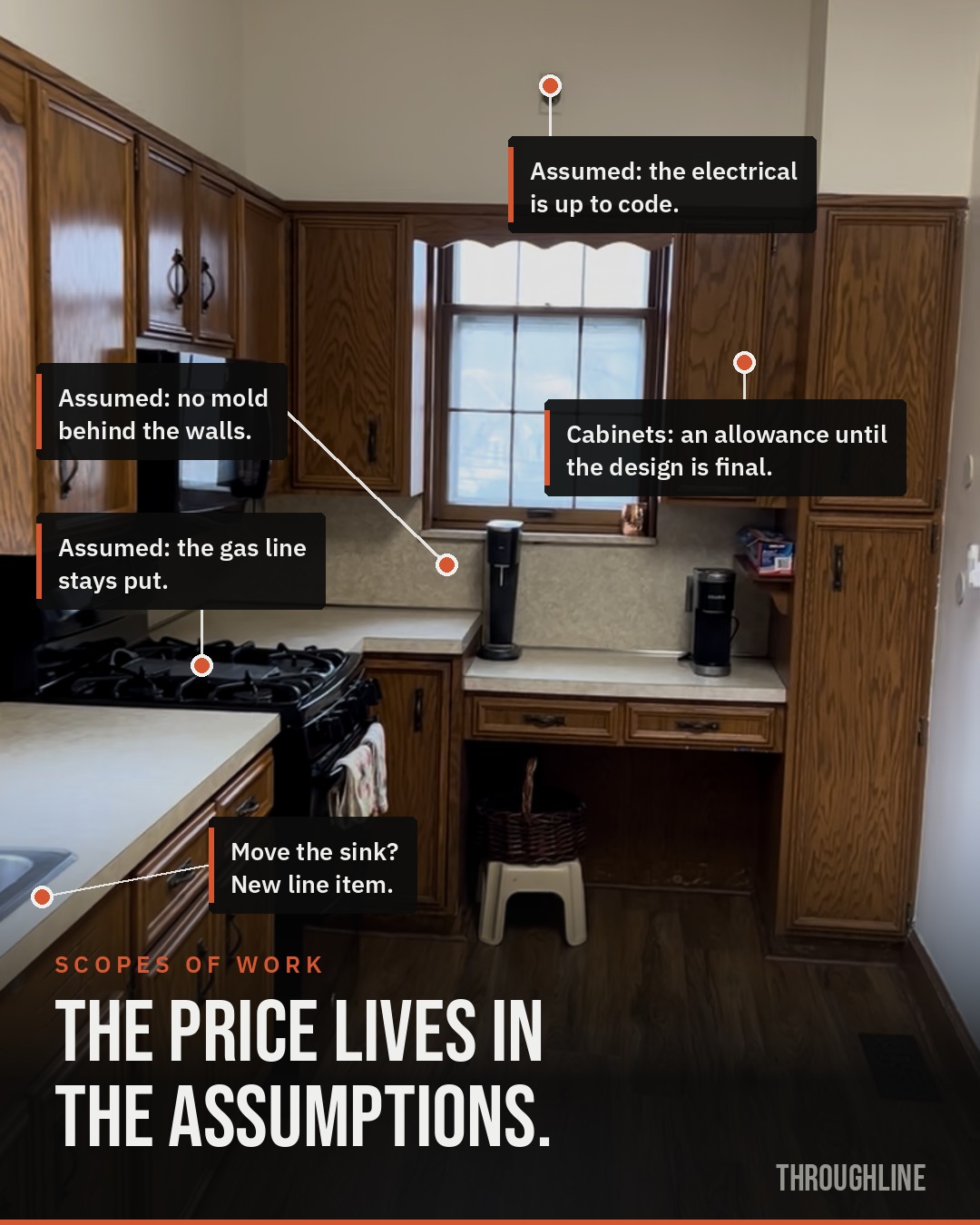
So let me explain one with a kitchen renovation. Mine, actually. The photos are my kitchen, before and after.
You don't start a renovation by swinging a sledgehammer. You start with a design. So the first phase of the scope is just that: a designer draws up the plans, with two rounds of review built in. You give feedback, they refine.
Want a third and fourth round? That's more time, so it's more money. The rounds are in the scope for a reason. In an agency scope, rounds of review work exactly the same way, and they're one of the biggest drivers of cost.
Here's the part people miss. When you sign the contract, you don't yet know what the cabinets will cost. Or the countertops. You can't, because the design isn't final.
So a good scope sets money aside for each of those, based on what's known today, and says plainly: we'll revisit these numbers once the plans are locked. That's not the contractor being slippery. That's an honest scope handling what nobody can know yet.
Agency scopes do the same thing with production, media or talent costs that depend on the creative idea.
Then come the assumptions. A kitchen scope might assume:
That's not fine print. That's the deal. Every price is built on assumptions like these, and an agency estimate is no different: how many deliverables, how many markets, how much feedback, who supplies what and when.
Watch what happens when one of them breaks.
The wall's open, and you decide you'd like the sink on the other side. That means moving the water and gas lines. It wasn't in the scope. New line item, new cost.
The same goes if you're late with the appliances you said you'd supply. The crew is standing in a half-built kitchen with nothing to install. That delay is on you.
Or you tell the contractor you're going out of town for a month and want to pause, then pick up where you left off at the same price. But they booked their crew for those weeks and turned down other work to hold your dates. Your kitchen can take a month off. Their crew can't.
But it cuts both ways. During my renovation, the crew cut a pipe that fed the radiators. The pressure valve on our boiler started leaking, and there was water across the basement floor.
That isn't a change order. You hire professionals because they're supposed to know where the pipes are. When their work causes the problem, fixing it is on them.
It's the same as a production company shooting your commercial and coming back with unusable footage. You don't pay for the reshoot. They do. You hired them for their judgment and experience, and when that's what fails, the cost is theirs.
We didn't find mold behind our walls. Plenty of people do. Nobody could see it when the job was priced. The timeline moves, and so does the budget. That isn't anyone being careless. It's reality showing up, and a good scope says in advance how it will be handled.
None of this is anyone being difficult. The scope sets the boundaries, and real projects lean on them. Duration drives the money. Assumptions decide who pays when reality shows up.
But here's the most important part. A scope is a contract, yes. It's also two groups of people trying to make something good together. The best agencies don't wave the document around every time the wind shifts. They look out for the client, absorb the small stuff, and flag a problem before it becomes a bill.
The contract sets the floor. The relationship sets the standard.
A good statement of work does what a good renovation contract does. It says what's being built, what's being assumed, how long it takes, and what happens when something changes. Get that alignment up front and treat each other well once the work starts, and the project has a chance. Skip it, and you'll have the argument later, with the wall already open.
A clear description of what's being made, the phases and timeline, the number of review rounds, the fees, any allowances for costs that can't be known yet, the assumptions the price is based on, and how changes will be handled.
Assumptions are the conditions the price depends on, such as the number of deliverables, rounds of feedback, or materials the client will supply. If an assumption turns out to be wrong, the cost or timeline can change.
An allowance is money set aside for a cost that can't be known when the contract is signed, such as cabinets in a renovation or production costs that depend on a creative idea. It's revisited once the details are final.
A change order is a formal update to the scope when the client changes what they want or an assumption no longer holds. It adds a new line item with its own cost and timeline.
Usually the agency or contractor. Clients pay for professional judgment and experience, so when a mistake comes from poor work, fixing it is normally the provider's cost, not a change order.