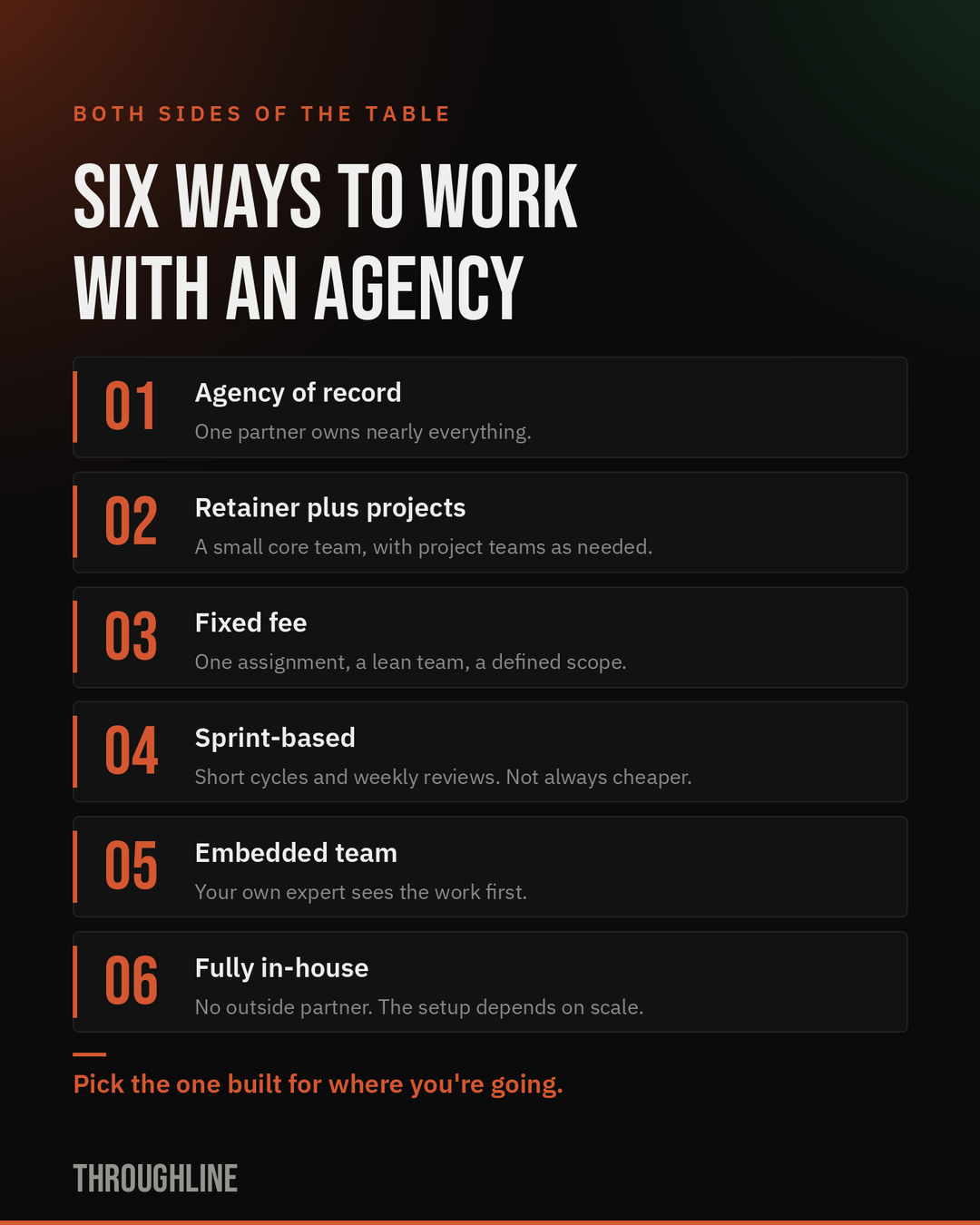
There are six ways to structure the relationship between a brand and a creative agency. I've worked inside all six.
None of them is universally right. The right one depends on your budget, your team and where you intend to be in five years. Here they are.
One partner owns nearly everything. Large retained teams, layers of personnel, and a client lead, a strategy lead and a creative lead.
It made sense when a brand needed one firm to do everything. Outside the biggest advertisers, it's dying.
A small core team stays on your business all year, and project teams come in when the work demands them. You keep the people who know your business and stop paying to retain capacity you don't use.
It's also fading, because many brands now build that core team themselves.
One assignment, a lean team and a defined scope, with no standing overhead.
Excellent when the need is clearly bounded. Less so when you want a partner who knows your business deeply.
Not new. It has existed in digital product development for decades. Short cycles, weekly reviews and work shown before it's finished.
It builds trust and catches errors early. It can also lengthen the schedule and raise the cost, because feedback on unfinished work can change direction mid-stream. Don't assume it's cheaper. It often isn't.
You employ a creative director or strategist who sees the agency's work before anyone else does. This adds judgment early.
It only works if that person has the authority to change the work. If all they can do is review it, you've added a step, not a safeguard.
No outside partner. The right setup depends heavily on scale: what suits a marketing department of a hundred bears no resemblance to what suits a department of ten.
Don't ask which model is best. Ask which one fits your budget, your people and where you're going.
Then look honestly at your current engagement model. If it was built for the company you were three years ago, it's time to change it.
The six common models are agency of record, retainer plus projects, fixed fee, sprint-based, embedded team and fully in-house. Each fits a different combination of budget, team and business goals.
Mostly by the largest advertisers. For most other brands, it has been replaced by leaner arrangements such as project work, fixed-fee assignments or in-house teams.
Not necessarily. Sprints build trust and catch errors early, but feedback on unfinished work can change direction mid-stream, which can lengthen the schedule and raise the cost.
Match the model to your budget, your internal team and where the business is heading. Review it regularly, since a model built for the company you were a few years ago may no longer fit.