Performance marketing is easy to love. You spend a dollar, you see a click, you see a sale. It's in the dashboard by Friday, and it looks like perfect attribution.
Brand building is harder to love. You spend now, and the payoff shows up later, in ways that are harder to directly measure and attribute.
So when budgets get tight, the money often drifts toward what's easy to count.
I've seen what that does. I once worked on a CPG brand that was cheap to make and highly profitable, so profitable it helped fund advertising for other brands in the portfolio. Nobody was advertising the product itself anymore.
For years, that looked like smart math. Then the brand started losing salience, slowly, the way brands do. When it finally got investment again, it came back.
Any brand that's doing well today can coast on the equity it built years ago, until it runs out. Brand equity doesn't hold still. It either gets maintained or it wears down.
People don't buy what they're loyal to as much as we'd like to think. They buy what they remember. Byron Sharp makes that case in How Brands Grow, and I've come around to it for a lot of brands.
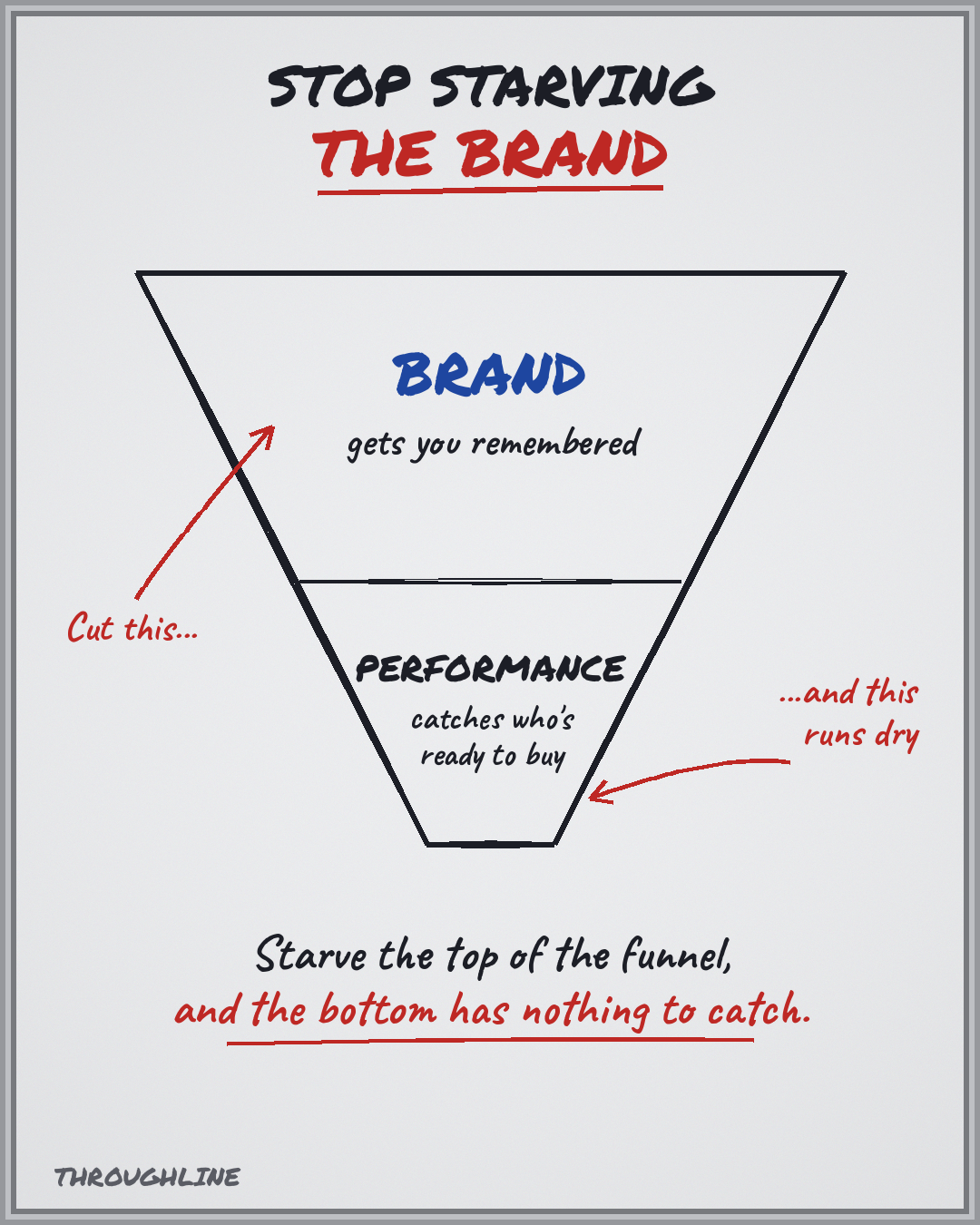
That's the difference between the two jobs:
Cut the first, and over time the second has less to work with.
When I look at a marketing operation, I put three things side by side: what you spend, what you make and what it actually does for the business.
Very often, brand building is the first thing cut and the last thing measured. Before cutting it, ask how you'd know what it was doing for you, and what would happen to demand a year from now without it.
Starve the top of the funnel, and eventually the bottom has nothing left to catch.
Brand marketing builds awareness and memory, so people think of you when they're ready to buy. Performance marketing targets people who are already close to buying and drives immediate, measurable actions like clicks and sales.
Because its results are harder to measure and show up over a longer period. Performance marketing produces quick, visible results, so budgets tend to drift toward it when money is tight.
Its salience, meaning how readily people think of it, gradually declines. Sales may hold for a while on existing brand equity, but over time demand weakens.
There's no universal split. The right balance depends on your category, how established your brand is and your business goals. What matters is investing in every part of the customer journey, not only the part that's easiest to measure.