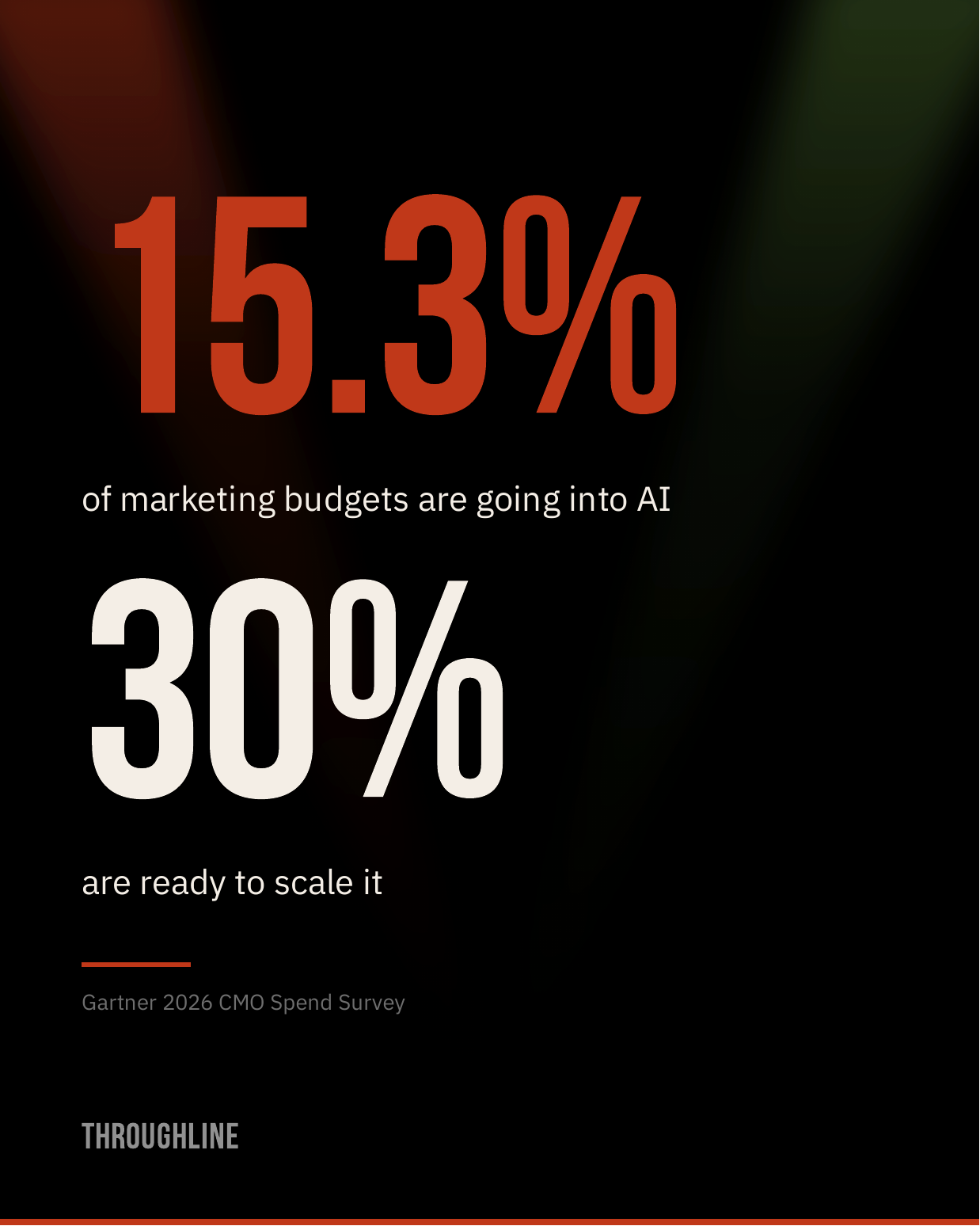
CMOs are putting an average of 15.3% of their marketing budgets into AI. Only 30% say their AI capabilities are mature enough to scale.
That's from Gartner's 2026 CMO Spend Survey of 401 marketing leaders, most at companies with more than $1 billion in revenue. So roughly seven in ten are funding a capability their processes can't absorb yet, and these are the organizations with the most infrastructure to begin with. I'd be surprised if mid-size companies were doing better.
That gap isn't a problem with the tools. Picking AI products and rolling them out isn't implementation. It's buying a subscription and using it sometimes.
Implementation is a set of questions most teams never answer.
1. Where does this sit in the path the work travels? If you can't name the step it replaces, you haven't saved work. You've added it.
2. Who reviews the output for quality, and can they absorb the extra work? AI output still needs a person to check it. If the reviewers are already at capacity, the bottleneck just moves.
3. Which roles change, and has anyone told them? New tools change jobs. People who find that out after the fact resist it.
4. What do we stop doing now that this exists? This is where the savings actually live. If nothing stops, nothing is saved.
None of this is new. When spelling and grammar check arrived in Microsoft Word, it changed how people worked. It got things wrong and needed a person to check it, but it soon became second nature. It didn't replace the work. It changed how people worked and what they spent their time on.
That's how I see AI: as a productivity tool that changes the work, not one that does it for you.
I've spent my career building new capabilities, at agencies, at Amazon and now at Throughline. In every one of those places, the tools arrived years before the way of working caught up.
That used to be fine. The gap closed on its own eventually, and the cost of waiting was low.
That's what's different now. The tools are moving faster than any organization adapts on its own, and the market has moved with them. The gap doesn't close by waiting anymore. It widens.
The operating model is the part you have to decide to build.
According to Gartner's 2026 CMO Spend Survey, CMOs allocate an average of 15.3% of their marketing budgets to AI initiatives, but only 30% report mature or fully developed AI readiness capabilities.
Usually because the tools are bought without changing how work gets done. Without deciding where AI fits in the workflow, who reviews its output and what work stops, it adds steps instead of saving them.
Answer four questions: where AI sits in the path the work travels, who reviews its output and whether they have capacity, which roles change, and what the team stops doing now that the tool exists.
In most marketing teams, AI changes the work more than it replaces it. Like spell check, it needs people to review its output and shifts what they spend their time on.